
Hokum. Merriam-Webster’s definition states that a device used (as by a showman) to evoke a desired audience response. Also, “pretentious nonsense.” The title of Damian McCarthy’s latest movie was the first thing to pique my interest. The second was that it received praise from other critics and was recognized as the best horror movie of the year. What occurred during my watch was the filmmaker’s calculated effect on my reactions and cosigning on what other critics are saying.
This might be the best horror movie of 2026.
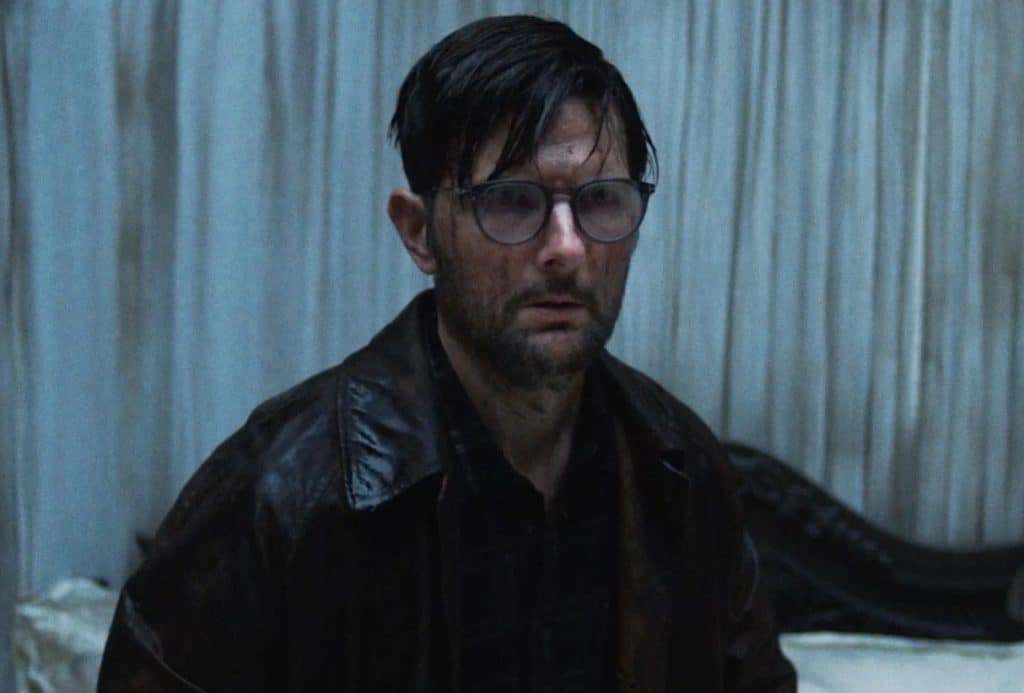
Hokum, directed and written by McCarthy, stars Adam Scott as writer Ohm Bauman, who has just completed his trilogy of books. To “celebrate”, Bauman takes the ashes of his parents to an isolated hotel in Ireland to spread their remains. While there, Bauman makes a life-altering choice that aligns with the hotel’s haunted legend. That description may come off as a run-of-the-mill ghosting story; however, Hokum has several twists and turns that add layer upon layer of meaning.
One of the highlights that Hokum brings is Adam Scott’s performance. The actor is generally known for playing nice-guy roles with varying degrees of complexity. Hokum allows Scott to dig deeper into the latter while showcasing a less-explored side of his acting. Bauman is an a**hole in the film, but clearly an individual who’s unaware of how to confront his demons. He uses that notion and takes it out on the people around him.
Scott doesn’t do it in a way that makes his character entirely unlikable. Yet the actor uses subtle forms of rudeness to showcase that he’s a lost man. Hokum takes it further throughout the movie by having him display levels of regret, depression, and suicidal tendencies in an effective way that makes the character’s arc fully engaging. All this culminates in Bauman coming to terms with a tragic event in his past. This moment hits like a ton of emotional bricks and showcases Scott’s talent as an actor.
Additionally, my admiration for the film doesn’t end there.
McCarthy’s writing and directing are a perfected blend of themes exploring isolation, death, and suicide, with hints of Dante’s Inferno. The director’s use of negative space and jump scares gives Hokum an atmospheric level of horror. He gave me these moments of silence to let my imagination dig its own hole of terror, adding more to its story-driven effect. Several scenes in Hokum made me wince in fear, but I couldn’t resist watching. A great example of this feature is an intense, drawn-out scene involving an elevator, Bauman running for his life, and a little piece of chalk that saves him.
Absolutely brilliant.
McCarthy’s writing unveils some of the movie’s themes in a very hard-hitting yet slow-burning way. The script for Hokum starts with the story of a man in search of a treasure that’ll solve all his problems. However, the story ends bleakly, telegraphing the character’s thoughts and feelings, which ripple throughout the movie. That rippling effect grows at an even, subtle pace that matches well with the horror and visual elements. Furthermore, McCarthy sprinkles humor in those well-deserved moments when the movie needs a breather.
All these expertly executed sequences wrap the movie up into a thoroughly combined feeling of a ghost story, witchcraft, a descent into Hell, being lost, and appreciating life. It’s like McCarthy took the many things that make Japanese Horror work and put his spin on it. The build to a crucial moment in the 3rd Act was worth it, and finally, the moments brought at the end were the much -deserved cherry on top.
McCarthy knew exactly what he wanted from Scott, his vision, and how to bring them to life. Honestly, I thought all the hype about the movie was just that—hype. Conversely, I’m glad to be proven wrong and share that Hokum is a highly recommended horror film with so much to say about death on a deeper level. Along with this review, I’d like to say that I personally felt connected with Hokum. Suicidal ideation, a life filled with regret, and finding peace and acceptance feels like a journey into Hell.
This is a movie that helps people understand that and the battles we fight within ourselves and the demons we carry. Hokum has heavy subjects, but McCarthy’s writing and direction make those subjects more digestible. Highly recommend it.