
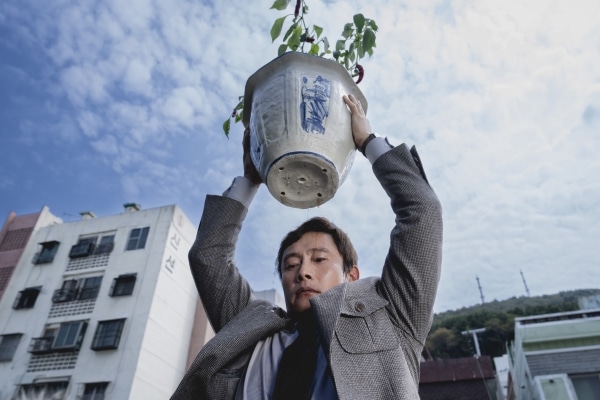
Park Chan-wook is widely regarded as one of the most interesting—if not the best—directors working today. His internationally renowned Old Boy film is on many film critics’ Best Of lists of the best movies of all time. The director has been working steadily for some time and is even tapping more into his dark humor wheelhouse. Many of his films, like Thirst, The Handmaiden, and Decision to Leave, incorporate dark comedy, a style that has become synonymous with the director. His most recent film, No Other Choice, leans further into that element but carries an underlying message about corporatism and the brutal job market plaguing our society today.
Although all those elements work alongside Chan-wook’s visual storytelling and show another hit from the director, the film still has some apparent issues that really hold it back.
No Other Choice, directed by Chan-wook, features the filmmaker collaborating with writers Lee Kyoung-mi, Jayne Lee, and Don McKeller. The story follows Man-soo, a paper industry expert played by Lee Byung-hun. After 25 years of dedication to his company, Man-soo is let go due to a corporate takeover and is unable to find sustainable work for years. He and his wife, Mi-ri, played by Son Ye-jin, are on the verge of bankruptcy when Man-soo makes one last-ditch effort to find work. Soo discovers a job opportunity that will solve all of their problems, but there has to be a body count to make it happen.
Think of the movie as if Michael Scott from Dunder Mifflin lost his job and had to literally kill the competition to find another one just as suitable.
One of the many aspects of No Other Choice that should draw interest is the performance of Byung-hun. Many fans of Asian cinema have appreciated his skills showcased in JSA, A Bittersweet Life, I Saw The Devil, and Squid Game. The actor’s talent is on full display as he perfectly balances comedy, caring, and darkness. Byung-hun is a fascinating actor and is well-suited to this type of role.
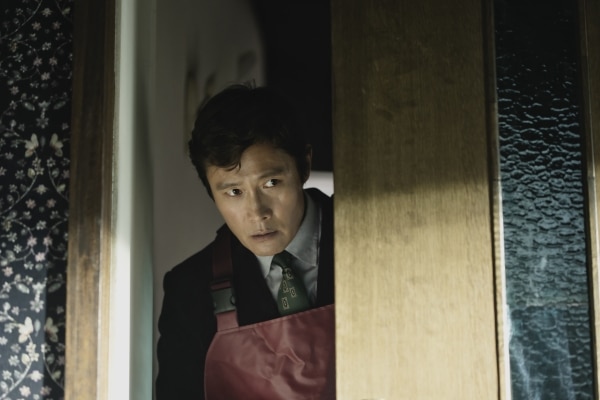
His character comes off as someone who has appreciated what he had built and his family. Soo is the embodiment of “wholesome” in No Other Choice, and Byung-hun’s expert acting takes the character on an interesting transformation. He starts as a family man and hard worker, to a desperate unemployed individual, to being torn on the inside for committing murder, all the way to a sociopath with so much subtlety.
Son Ye-jin handles well on her own despite not being in the movie a whole lot. However, her scenes carry so much weight in the film as a wife and mother who is slowly seeing her husband begin to crack. There’s a fantastic scene in the third act where Jin’s performance culminates in a metaphorical crossroads. Her reaction and the way she makes her decision are so authentically convincing that they scream the many instances in which people have to accept and cover up their partners’ actions. It gave me this feeling of everlasting torment from Mi-ri, but it was the justifiable choice to keep their family together.
Another thing to consider is what works so well for No Other Choice is the dark humor.
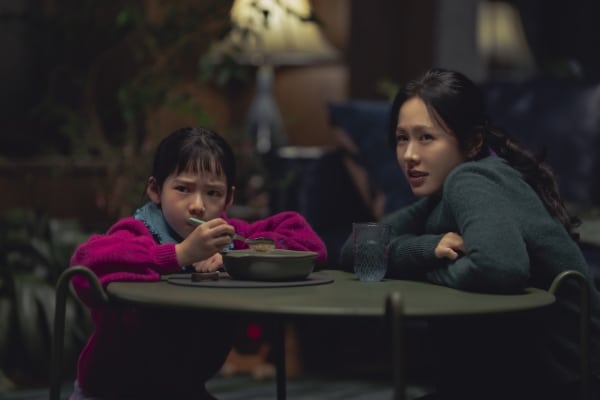
Chan-wook always has a level of comedy in his movies, though it might be dark or very dark. Consequently, the filmmaker and his writing partners go a bit harder and more consistently than Chan-wook’s previous work. Several comedy beats are cleverly placed around the movie. A strong example of this is when Man-soo commits his first murder.
Man-soo finds an opportunity to commit the act, but the scene devolves into the character seeing a comedic reflection in his victim. The moment continues to play out hilariously when his victim’s marital problems become the primary focus of the situation, and the tension rises when everyone begins fighting for the gun. The scene carries a rippling effect as Man-soo even uses the man’s words in a later argument with his own wife, and how cleverly the writers make more sense of Soo’s argument. It’s one of many components of the writing that allowed me to evolve with the character and dig deeper into his mindset and overarching arc.
The writing blends seamlessly with Chan-wook’s talent for transition scenes and for setting up moments with a huge impact. In No Other Choice, Soo is skillful at binding trees and plant branches, giving off a methodical, expert vibe. This moment pays off fascinatingly, leading to a showcase of crossing another severe line to find a job. Another great point of Chan-wook’s directing, messing with the writing, is the importance of trees. Several great shots characterize Man-soo as a person fully dedicated to the art of papermaking and to respecting nature.
Most of this works out for the movie; however, some of the filmmaker’s message becomes too heavy-handed.
Many parts of No Other Choice started hitting me over the head with its subtext about how we and corporations are destroying nature. At first, I was able to roll with it and fully digested what Chan-wook was serving. Yet, it’s the montage of real-life forests being destroyed that gave me more than I needed. The underlying message had been carefully placed: the sudden jolt in narrative storytelling almost took me out of the movie.
Look, I’m a sucker for a Park Chan-wook movie. You’re more than likely to see me at the theater on Day One whenever the director has another project. No Other Choice still gave me my Chan-Wook fix, but the multiple writers make some elements of the underlying message feel sloppy. In many cases, it’ll hit like an obscenely heavy hammer. Besides that, still check it out.